


Key Takeaways
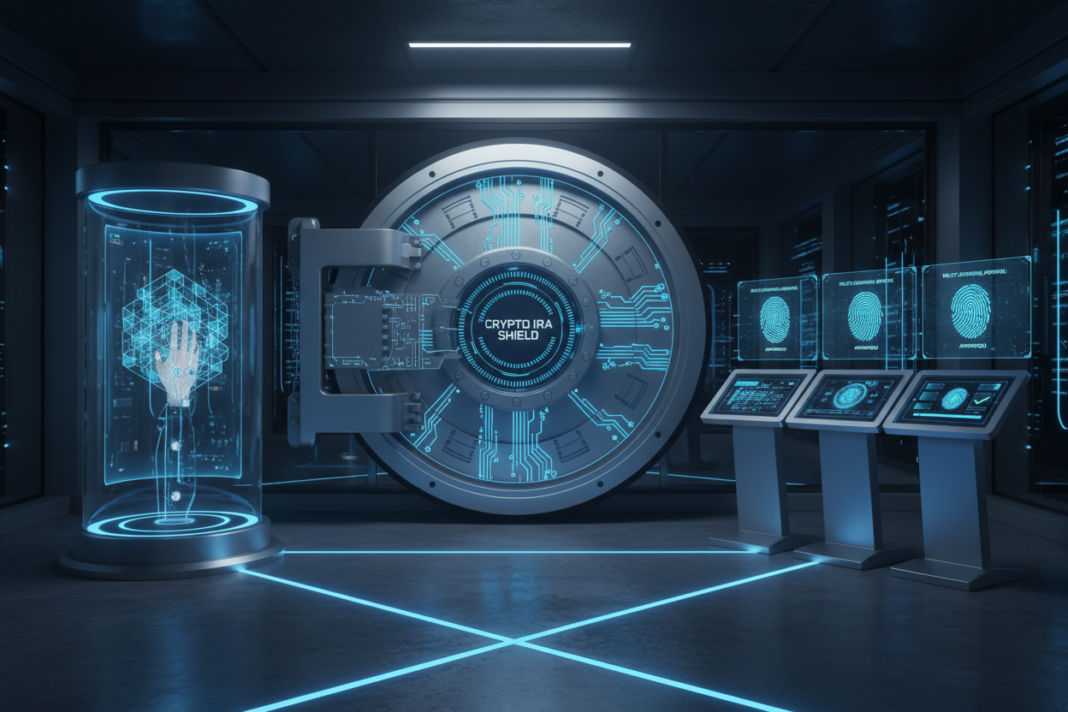
- Cold storage technology has evolved beyond basic hardware wallets to include air-gapped vaults and distributed architecture systems that significantly reduce hack vulnerability.
- Multi-signature authorization requiring 3-5 separate approvals has become the gold standard for crypto IRA security, preventing single-point failures.
- Insurance coverage for crypto assets has matured, with specialized policies now available through established insurers like Lloyd’s of London.
- Biometric authentication methods including fingerprint, facial recognition, and voice pattern verification provide additional layers of security for crypto retirement accounts.
- BitIRA offers institutional-grade security protocols through their partnership with Gemini custody, making them an ideal solution for security-focused retirement investors.
The digital asset revolution has created unprecedented opportunities for retirement investors, but with those opportunities come unique security challenges. Traditional IRAs hold assets safeguarded by established financial institutions with centuries of security protocols. Crypto IRAs, however, require a completely different security approach to protect your digital retirement assets from sophisticated threats.
Why Your Retirement Crypto Needs Military-Grade Protection
Your retirement savings represent years of hard work and sacrifice. When those savings include cryptocurrency, they become targets for a global network of hackers with increasingly sophisticated tools at their disposal. Unlike traditional retirement accounts where transactions can be reversed and theft is often insured, cryptocurrency transactions are immutable. Once your crypto is gone, it’s generally gone forever. This fundamental difference is why BitIRA and other leading providers have pioneered military-grade security protocols that go far beyond what you’d find at conventional financial institutions.
The stakes couldn’t be higher when it comes to securing your crypto retirement funds. A single successful attack could potentially wipe out decades of careful planning and investing. This isn’t just theoretical – crypto exchanges and platforms have lost billions of dollars to hackers over the years. Your IRA deserves better protection than what standard exchanges typically offer.
Traditional vs. Crypto IRA Security: The Critical Differences
Traditional IRAs rely heavily on centralized security systems, federal insurance programs like FDIC, and the ability to reverse fraudulent transactions. Crypto IRAs operate in a fundamentally different environment where these safety nets don’t exist in the same form. Understanding these differences is crucial for anyone considering adding digital assets to their retirement portfolio.
Unique Vulnerabilities of Digital Assets
Digital assets face attack vectors that simply don’t exist for traditional investments. Private keys, the cryptographic codes that prove ownership of cryptocurrency, become prime targets for sophisticated attackers. A compromised private key means complete loss of the associated assets. This is fundamentally different from traditional financial systems where proof of identity can restore access to accounts.
Crypto transactions also face risks during the transaction process itself. Man-in-the-middle attacks, clipboard hijacking, and phishing schemes specifically target cryptocurrency transactions. These attacks attempt to redirect funds during the brief window when assets are being transferred, taking advantage of the pseudonymous nature of blockchain addresses.
Smart contract vulnerabilities present another unique risk for certain cryptocurrencies. Unlike simple assets like Bitcoin, programmable blockchains introduce the possibility of code exploits that can drain funds from otherwise secure wallets. This is why institutional-grade security for crypto IRAs must account for both traditional security threats and blockchain-specific vulnerabilities.
The Irreversible Nature of Blockchain Transactions
Perhaps the most significant security difference between traditional and crypto IRAs is transaction finality. When cryptocurrency leaves your wallet, there’s no bank to call, no fraud department to investigate, and no insurance that automatically covers your loss. Blockchain transactions are designed to be permanent and immutable.
This irreversibility is what makes advanced security measures absolutely essential for crypto retirement accounts. The technology must prevent unauthorized transactions from happening in the first place, rather than dealing with them after the fact. Leading crypto IRA providers have developed multi-layered approval systems specifically designed around this reality.
Legal Protections Gap
Traditional retirement accounts benefit from decades of established regulations, consumer protections, and standardized security protocols. Crypto IRAs operate in a relatively new regulatory environment where legal protections are still evolving. This protection gap means that technical security measures must be even more robust to compensate.
While the IRS has provided guidance on cryptocurrency taxation within retirement accounts, the regulatory framework around security standards remains less defined than for traditional assets. Forward-thinking crypto IRA providers address this by implementing security measures that exceed requirements, anticipating future regulations rather than merely complying with current ones.
Cold Storage Evolution: Beyond Basic Hardware Wallets
Cold storage – keeping private keys completely offline – forms the foundation of crypto IRA security. However, the technology has evolved far beyond simple hardware wallets or paper backups. Today’s institutional-grade cold storage implements sophisticated systems that distribute risk while maintaining accessibility for legitimate transactions.
The most secure crypto IRA providers use customized cold storage solutions specifically designed for institutional requirements, not consumer-grade hardware wallets. These enterprise solutions incorporate redundancy, geographic distribution, and proprietary security techniques that simply aren’t available in retail products. For those interested in hardware wallets, check out this Trezor Safe 3 review for more insights.
Air-Gapped Cold Storage Vaults
Leading crypto IRA security systems now employ air-gapped computers that never connect to the internet, housed in physical vaults with multiple security layers. These systems generate and store private keys in environments physically isolated from potential remote attacks. Transaction signing occurs on these isolated systems, with approved transaction data transferred through secure, one-way methods that prevent infiltration.
Air-Gapped Cold Storage Vaults
Leading crypto IRA security systems now employ air-gapped computers that never connect to the internet, housed in physical vaults with multiple security layers. These systems generate and store private keys in environments physically isolated from potential remote attacks. Transaction signing occurs on these isolated systems, with approved transaction data transferred through secure, one-way methods that prevent infiltration. For more insights into securing your cryptocurrency investments, explore the best crypto IRA options.
BitIRA’s security protocol exemplifies this approach, utilizing specialized hardware security modules (HSMs) that never directly connect to networked computers. These military-grade devices are designed to detect and resist physical tampering attempts, automatically erasing sensitive key material if breach attempts are detected. This hardware-enforced security provides protection that software-only solutions simply cannot match. For more insights into security measures, check out this article on security for new bitcoin strategic reserve.
Distributed Storage Architecture
Modern crypto IRA security implements distributed storage architecture that divides private keys into multiple encrypted shards, each stored in separate secure locations. This approach ensures that no single location contains enough information to reconstruct a complete private key. For a transaction to be authorized, these fragments must be temporarily reassembled through a secure process requiring multiple independent authorizations.
The practical implementation involves storing key fragments in geographically separated secure facilities, often on different continents. Each location has its own security protocols, access controls, and surveillance systems. Some providers even maintain backup shards in specialized disaster-resistant facilities designed to withstand extreme events like electromagnetic pulses or natural disasters.
Physical Safeguards and Geographic Redundancy
The most secure crypto IRA providers complement digital protections with extensive physical security measures. These include biometric access controls, 24/7 armed security personnel, Faraday cages to block electromagnetic signals, and redundant power systems. The physical infrastructure resembles high-security banking facilities more than typical data centers.
Geographic redundancy plays a crucial role in this security model. By distributing crypto assets across multiple locations, providers ensure that localized disasters or security breaches cannot compromise the entire system. This redundancy covers not just the physical storage of key material but also the infrastructure for transaction verification and processing. For a comprehensive understanding of security features in crypto wallets, you can refer to our Edge Wallet review.
Military-Grade Encryption Standards
Institutional crypto storage employs encryption standards that meet or exceed military specifications. This typically includes AES-256 encryption, elliptic curve cryptography, and multiple layers of encryption applied to already-encrypted data. These encryption systems are regularly updated to address emerging threats and newly discovered vulnerabilities. For more on secure crypto storage, you can explore security measures for Bitcoin reserves.
Beyond the encryption itself, secure key management becomes equally important. The systems for generating, storing, and using encryption keys involve specialized hardware specifically designed for cryptographic operations. These systems implement concepts like key rotation, where encryption keys are regularly changed, and key sharding, where keys are split among multiple custodians.
Multi-Signature Technology: The New Gold Standard
Multi-signature technology has emerged as perhaps the single most important security innovation for institutional crypto storage. Unlike traditional single-key wallets where one private key controls the entire wallet, multi-signature requires multiple independent keys to authorize any transaction. This dramatically reduces the risk profile by eliminating single points of failure.
How 3-of-5 Multi-Sig Actually Works
The most common implementation for high-security crypto IRAs is a 3-of-5 multi-signature arrangement. This configuration generates five separate private keys, with any transaction requiring signatures from at least three of these keys. The keys are typically distributed among different stakeholders, including the custodian, the security provider, and cold storage facilities.
Example 3-of-5 Multi-Signature Implementation
Key 1: Held by primary custodian in secure facility
Key 2: Held by secondary custodian in geographically separate location
Key 3: Stored in deep cold storage vault with time-delay access
Key 4: Distributed to secure backup location for disaster recovery
Key 5: Emergency recovery key with specialized access requirementsThis arrangement ensures that no single entity can unilaterally access or transfer funds. Even if hackers somehow compromised one key holder, they would still need to breach at least two additional secure systems to reach the transaction threshold. This security model effectively transforms what would be a single high-value target into multiple targets that must be compromised simultaneously, as highlighted in the Trezor Model T review.
Role-Based Authorization Controls
Advanced multi-signature implementations incorporate role-based controls that restrict which keys can authorize specific transaction types. For example, certain keys might only have authority for transfers below a specific threshold, while others are required for larger transactions. This creates a graduated security model where routine transactions face fewer hurdles than potentially risky large withdrawals.
Some systems even implement purpose-specific keys that can only authorize transactions to pre-approved wallet addresses. This approach prevents funds from being diverted to unauthorized destinations even if multiple keys were compromised. The result is a highly granular security model tailored to the specific operational needs of a crypto IRA.
Time-Locked Transactions for Added Protection
Time-locked transactions add another layer of security by introducing mandatory delays between transaction initiation and execution. When a withdrawal is requested, the system initiates a waiting period of 24-72 hours before the transaction can be finalized. During this period, automated systems and human reviewers verify the legitimacy of the request, and notifications are sent to account owners through multiple channels.
This time-delay mechanism effectively creates a circuit breaker against both external attacks and insider threats. It provides a window for detecting fraudulent activity before funds leave the system, similar to how traditional banks place holds on large deposits. The most advanced implementations also include escalating verification requirements based on transaction size and destination, as seen in the Trezor Model T hardware wallet.
Biometric Authentication Breakthroughs
Biometric authentication technologies have transformed crypto IRA security by adding unique physical identifiers to the authorization process. These systems go beyond simple passwords or security questions, requiring verification of biological characteristics that are extremely difficult to forge or steal. Leading providers now implement multiple biometric factors as part of their comprehensive security architecture.
Fingerprint Integration with Hardware Security Modules
Advanced hardware security modules now integrate fingerprint verification directly into the device hardware. Unlike consumer smartphones that store fingerprint data in potentially vulnerable operating systems, these specialized devices process biometric data within secure enclaves that cannot be accessed by other system components.
Security Feature Consumer Grade Institutional Grade Fingerprint Resolution 500-1000 DPI 1500+ DPI with subsurface scanning False Accept Rate 1 in 50,000 Less than 1 in 1,000,000 Liveness Detection Basic Advanced with pulse and temperature sensing Data Storage Device secure enclave Encrypted within HSM hardware boundary These institutional-grade fingerprint systems implement advanced “liveness detection” to prevent spoofing attempts using artificial fingerprints. The scanners check for natural characteristics like subtle pulse variations, temperature patterns, and the natural electrical conductivity of living tissue. Some systems even incorporate micro-movement analysis that detects the minute, unconscious movements present in living fingers.
For crypto IRA providers like BitIRA, fingerprint authentication serves as just one component in a multi-layered verification process. By requiring fingerprint verification alongside other factors, the system maintains security even if a single authentication method were somehow compromised.
Facial Recognition Safeguards
Facial recognition technology has evolved far beyond the capabilities found in consumer devices. Institutional systems now employ 3D mapping technologies that create detailed depth models of facial features, making them virtually impossible to fool with photographs or video recordings. These systems analyze over 30,000 unique facial points to create authentication templates that are both highly accurate and resistant to spoofing.
The implementation of facial recognition in crypto IRA security typically includes multiple verification steps. Initial enrollment requires extensive validation of identity documents alongside the biometric enrollment. Subsequent authentication compares live captures against this securely stored template, with sophisticated algorithms that can detect inconsistencies while still accommodating natural variations like facial hair or aging. For more on the future of retirement investments, explore crypto in your IRA.
Voice Pattern Authentication
Voice biometrics add another security dimension by analyzing the unique acoustic patterns created by an individual’s vocal tract, mouth, and nasal cavities. Unlike simple voice recognition that matches words, these systems analyze hundreds of voice characteristics including harmonics, frequency patterns, and speech cadence. The resulting voiceprint is as unique as a fingerprint but can be verified remotely during phone transactions.
Advanced implementations use dynamic phrase generation rather than static passphrases. The system prompts users to speak randomly generated sentences, preventing replay attacks using recorded voice samples. Some systems also incorporate stress analysis that can detect unusual patterns potentially indicating duress or coercion during high-value transactions.
Multi-Factor Biometric Verification
The true security breakthrough comes not from any single biometric method but from the strategic combination of multiple biometric factors alongside traditional authentication methods. This multi-layered approach might require fingerprint verification for system access, followed by facial recognition for transaction initiation, and voice verification as a final confirmation step for large withdrawals.
By requiring multiple independent biometric factors, the system becomes exponentially more difficult to compromise. Even if attackers somehow obtained a perfect copy of one biometric factor, they would still face the challenge of simultaneously spoofing additional factors. This defense-in-depth strategy represents the current state-of-the-art in crypto IRA security.
Insurance-Backed Security: The Missing Piece
Insurance coverage has emerged as a crucial component of comprehensive crypto IRA security. Unlike traditional IRAs where FDIC insurance provides standardized protection, crypto asset insurance requires specialized policies developed specifically for digital asset risks. These tailored insurance solutions cover threats ranging from private key theft to insider collusion.
The most secure crypto IRA providers maintain multiple insurance layers, combining third-party commercial policies with self-insurance reserves. This approach ensures that customers have financial recourse even in scenarios where traditional insurance might have coverage gaps. BitIRA exemplifies this approach with their comprehensive insurance program covering both hot and cold storage assets against a wide range of threats.
Lloyd’s of London Crypto Policies
Lloyd’s of London and its syndicates have emerged as leaders in the crypto insurance space, developing specialized policies that address the unique risks of digital asset custody. These policies typically provide coverage against theft, loss of private keys, and certain types of social engineering attacks. The involvement of this centuries-old insurance market has brought much-needed legitimacy and standardization to crypto asset insurance.
Leading crypto IRA providers now secure coverage underwritten by Lloyd’s syndicates, with policies specifically designed for institutional digital asset custody. These policies often include detailed security requirements that custody providers must maintain, effectively creating industry security standards through insurance underwriting practices. Coverage limits have also increased substantially, with some providers now securing hundreds of millions in protection. For those interested in exploring crypto-friendly financial services, check out this comprehensive guide to Questrade.
The underwriting process for these policies involves rigorous security assessments that go far beyond typical cybersecurity audits. Providers must demonstrate comprehensive security architectures including cold storage protocols, key management procedures, and transaction verification systems. This intensive scrutiny benefits customers by ensuring providers maintain state-of-the-art security measures to qualify for coverage.
Coverage Limits and Exclusions to Watch For
While insurance represents a critical security layer, investors should carefully evaluate the specific terms of a provider’s coverage. Policy limits, exclusions, and claim processes vary significantly between providers. The most transparent companies will clearly disclose the scope of their insurance protection, including specific coverage amounts and the types of incidents covered. For those interested in alternative retirement options, consider exploring crypto IRA providers that offer unique insurance solutions.
Common exclusions in crypto asset insurance policies include losses resulting from software bugs, hard forks, or regulatory actions. Some policies also exclude coverage for assets held in hot wallets or those being actively traded. The most comprehensive protection comes from providers who maintain multiple insurance policies covering different risk categories, ensuring no significant gaps exist in their coverage framework.
Coverage Element Basic Provider Premium Provider Cold Storage Coverage Limited ($1-10M) Comprehensive ($100M+) Hot Wallet Coverage None or minimal Substantial with limits Private Key Loss Often excluded Included with verification Employee Theft Basic coverage Comprehensive with behavioral monitoring Third-Party Hacks Limited circumstances Broad coverage with few exclusions Self-Insurance Funds as Backup Protection
Beyond commercial insurance policies, top-tier providers maintain self-insurance funds that provide additional protection layers. These funds consist of assets set aside specifically to cover losses that might fall outside commercial policy parameters or exceed coverage limits. This approach demonstrates a provider’s commitment to customer protection and confidence in their security systems.
Self-insurance reserves are particularly important for covering emerging risks that traditional insurance markets haven’t yet developed standardized policies to address. As the crypto landscape evolves, new threat vectors may emerge faster than insurance products can adapt. Providers with substantial self-insurance capabilities are better positioned to protect customers against these evolving threats.
Zero-Knowledge Proofs: Verifying Without Exposing
Zero-knowledge proof technology represents one of the most significant security advancements for crypto IRAs. This cryptographic method allows a provider to prove they control the necessary assets without revealing sensitive information that could create security vulnerabilities. In practical terms, this means providers can demonstrate solvency and proper custody without exposing wallet addresses, balances, or transaction details that might attract attackers.
The implementation of zero-knowledge proofs effectively resolves the historical tension between transparency and security. Customers gain verification that their assets exist and remain properly secured, while the provider maintains the security benefits of keeping sensitive details private. This technology is particularly valuable for retirement accounts where long-term security takes priority over operational transparency. For enhanced security, consider using a hardware security key like YubiKey.
Regular Audits Without Compromising Security
Zero-knowledge audit systems enable regular verification of assets without introducing the security risks associated with traditional audit processes. Instead of granting auditors direct access to systems containing private keys or wallet information, these cryptographic methods generate mathematical proofs that assets exist and remain under proper control.
Advanced implementations include time-based verification that proves continuous custody rather than just point-in-time snapshots. This approach prevents schemes where providers might temporarily borrow assets to pass periodic audits. The most sophisticated systems generate real-time proof of reserves that customers can independently verify through cryptographic validation tools.
Proof of Reserves Technology
Proof of Reserves has evolved into a standardized verification approach specifically designed for crypto custodians. This technology allows providers to cryptographically prove they control sufficient assets to cover all customer holdings without revealing specific wallet addresses or transaction histories. The best implementations combine on-chain verification with zero-knowledge proofs to create comprehensive reserve validation.
Leading crypto IRA providers now conduct regular Proof of Reserve attestations, often supervised by independent accounting firms familiar with digital asset verification. These attestations typically include both verification of assets under custody and confirmation of proper segregation between customer and operational funds. The results provide customers with cryptographic certainty that their retirement assets remain secure without introducing new security risks through the verification process itself.
Regulatory Compliance Technologies
The intersection of cryptocurrency and retirement accounts creates unique regulatory compliance requirements. Specialized technologies have emerged to address these challenges, helping providers navigate the complex regulatory landscape while maintaining robust security. These compliance technologies have become essential components of a comprehensive security architecture for crypto IRAs.
Automated IRS Reporting Systems
Sophisticated reporting systems now automate the complex task of tracking and reporting cryptocurrency transactions for IRS compliance. These systems maintain detailed records of all transactions, calculate fair market values at the time of each transaction, and generate the documentation required for annual retirement account reporting. Advanced implementations include real-time monitoring of regulatory changes to ensure reporting remains compliant as tax rules evolve.
For customers, these automated systems eliminate the tax reporting headaches that often accompany cryptocurrency investments. All necessary documentation is generated automatically, with transactions categorized according to IRS guidelines. The most comprehensive systems also include audit support features that maintain the documentation necessary to substantiate reported values if questions arise.
BitIRA has pioneered integration between their security architecture and compliance reporting systems. This integration ensures that the same transaction verification mechanisms that protect against unauthorized access also maintain the integrity of tax reporting data. The result is a seamless system that provides both security and compliance without requiring customer intervention.
KYC/AML Integration for Retirement Accounts
Know Your Customer (KYC) and Anti-Money Laundering (AML) requirements apply to crypto IRAs just as they do to traditional financial accounts. Advanced compliance technologies now integrate these requirements directly into the account establishment and transaction verification processes. These systems employ sophisticated identity verification methods including document validation, biometric matching, and database cross-referencing.
Modern implementations use risk-based approaches that adjust verification requirements based on transaction patterns and account characteristics. Routine transactions within established patterns face minimal friction, while unusual activity triggers enhanced verification steps. This adaptive approach maintains regulatory compliance while providing a smooth experience for legitimate transactions. For more information on secure storage solutions, consider exploring crypto IRA options.
Leading providers complement automated systems with specialized compliance teams that review flagged transactions and maintain relationships with regulatory authorities. This human oversight provides context and judgment that automated systems alone cannot deliver, ensuring both security and regulatory compliance are maintained even in complex scenarios. For enhanced security, consider using a hardware security key like YubiKey.
Digital Asset Tracking for Annual Valuation Reports
IRA regulations require accurate annual valuation reporting, presenting unique challenges for cryptocurrency assets with their price volatility and 24/7 markets. Specialized valuation systems address this by implementing standardized methodologies for determining fair market value at specific reporting timestamps. These systems typically incorporate data from multiple exchanges and pricing sources to establish defensible valuations that satisfy regulatory requirements.
Advanced implementations include historical price archiving that maintains verification of reported values long after the reporting period. This feature proves invaluable if questions arise during IRS audits or other regulatory reviews. The most sophisticated systems also track fork events, airdrops, and other complex scenarios that have special tax implications within retirement accounts.
Regulatory Compliance Evolution
2018: Basic transaction reporting with manual reconciliation
2020: Automated reporting systems with standardized valuation methodologies
2022: Integrated compliance platforms with real-time regulatory monitoring
2023+: AI-enhanced compliance systems that adapt to regulatory changes
The integration of these regulatory technologies with security systems creates a comprehensive protection framework that addresses both external threats and compliance risks. This integration is particularly important for retirement accounts, where regulatory violations could potentially threaten the tax-advantaged status of the entire account.
How to Evaluate a Crypto IRA Provider’s Security
Selecting a crypto IRA provider requires careful evaluation of their security infrastructure. While many providers make similar security claims, significant differences exist in implementation quality and comprehensive protection. The following framework helps identify providers with truly institutional-grade security rather than merely adequate protection.
8 Non-Negotiable Security Features
- Cold storage majority – At least 95% of assets should be held in true cold storage with air-gapped signing.
- Multi-signature implementation – Minimum 2-of-3 signature requirement, with 3-of-5 or better for optimal security.
- Insurance coverage verification – Documented policies from reputable insurers with clear coverage terms.
- SOC 2 Type 2 certification – Formal audit verifying security controls operate effectively over time.
- Regulated qualified custodian – Partnership with custodians operating under banking or trust regulations.
- Transparent reserve verification – Regular proof-of-reserve attestations by independent third parties.
- Comprehensive disaster recovery – Documented procedures for catastrophic events with regular testing.
- Multi-factor authentication – At least three independent verification factors for critical account functions.
These essential features form the foundation of institutional-grade security for crypto retirement assets. Providers like BitIRA implement all these elements as part of their comprehensive security architecture, while less security-focused competitors may implement only some aspects or use consumer-grade versions that don’t provide equivalent protection.
Red Flags That Signal Weak Security
Certain practices indicate potentially inadequate security regardless of marketing claims. Watch for providers that emphasize convenience or low fees over security processes, as this often signals compromises in protection. Vague descriptions of security measures without specific details about implementation or verification should also raise concerns. For those interested in understanding more about secure options, consider reading a Trezor Model T review to see how hardware wallets enhance security.
Be particularly wary of providers who cannot clearly explain their key management processes or who store significant assets in hot wallets for extended periods. Another red flag is the absence of third-party security certifications or audits from recognized firms. Legitimate security leaders welcome external validation of their practices rather than relying solely on self-reported security claims.
The most concerning sign is any provider claiming to offer both maximum security and the lowest fees in the industry. Institutional-grade security requires significant investment in technology, personnel, and ongoing monitoring. Providers offering bargain-basement fees typically achieve those savings by compromising on security infrastructure that may not be apparent until a breach occurs.
Questions to Ask Before Trusting Your Retirement to Any Provider
Before entrusting your retirement assets to any crypto IRA provider, ask these specific questions to evaluate their security posture: Who exactly holds custody of the digital assets? What percentage of assets remain in cold storage versus hot wallets? What specific insurance policies cover the assets, and what are the coverage limits and exclusions? How are private keys generated, stored, and backed up?
Additionally, inquire about their security incident history and response procedures. Reputable providers maintain transparency about past incidents and the measures implemented to prevent recurrence. Ask how they’ve adapted their security in response to evolving threats and whether they employ dedicated security personnel or rely solely on third-party services.
Finally, request documentation of their regulatory compliance and security certifications. Legitimate providers should readily provide verification of their compliance status and share redacted versions of security audit results. Hesitation to provide this information often indicates security weaknesses they prefer not to disclose.
Future-Proofing Your Crypto Retirement Assets
The security landscape for digital assets continues evolving rapidly, making future-proofing an essential consideration for retirement accounts with decades-long horizons. The most forward-thinking providers implement adaptive security architectures designed to incorporate new protections as threats evolve. These systems emphasize security fundamentals that remain valid regardless of specific technologies, while maintaining flexibility to adopt emerging protections.
Quantum computing represents perhaps the most significant long-term threat to current cryptographic systems. Leading providers are already implementing quantum-resistant algorithms and developing migration paths for existing assets. This proactive approach ensures that retirement investments remain secure even as computational capabilities advance dramatically. BitIRA’s partnership with Gemini custody demonstrates this forward-looking approach, with ongoing research into post-quantum cryptography and regular security architecture updates.
The most effective future-proofing strategy combines technological measures with governance processes designed for adaptation. This includes regular security architecture reviews, threat intelligence monitoring, and dedicated research into emerging protection technologies. Providers committed to long-term security maintain active relationships with security researchers and participate in industry groups focused on developing new protection standards.
Frequently Asked Questions
The complex nature of crypto security often raises questions from retirement investors considering this asset class. The following answers address the most common concerns about crypto IRA security.
Can my crypto IRA assets be stolen even with advanced security?
While no security system can guarantee absolute protection, properly implemented institutional-grade security makes theft extremely unlikely. The multi-layered approach combining cold storage, multi-signature authorization, and insurance coverage creates multiple independent barriers that would all need to be simultaneously compromised. With providers like BitIRA implementing comprehensive security frameworks, successful attacks would require breaching multiple independent systems with different protection mechanisms – a scenario that becomes exponentially more difficult with each additional security layer.
Who holds the private keys in a crypto IRA setup?
In properly structured crypto IRAs, private keys are held by the qualified custodian in conjunction with their security partners, never by individual investors. This arrangement satisfies IRS requirements for retirement accounts while implementing institutional security practices. The most secure providers distribute key fragments among multiple independent parties using multi-signature technology, ensuring no single entity has complete control. This distributed approach prevents both external attacks and potential insider threats by requiring multiple independent verifications for any transaction affecting the assets.
How much additional cost do these security features add to crypto IRAs?
Institutional-grade security typically adds 1-2% in annual fees compared to less secure alternatives. This premium reflects the substantial investment in specialized hardware, security personnel, insurance coverage, and ongoing system monitoring required for true institutional protection. While these costs are higher than traditional IRAs, they reflect the fundamentally different security requirements for digital assets. When evaluating these costs, consider them essential insurance against catastrophic loss rather than optional expenses that can be eliminated to reduce fees. For more insights on crypto IRAs, you can explore diversification options available.
Are crypto IRAs FDIC insured like traditional retirement accounts?
No, crypto IRAs are not eligible for FDIC insurance, which only covers cash deposits in banking institutions. However, reputable crypto IRA providers maintain commercial insurance policies specifically designed for digital assets. These policies, often underwritten by Lloyd’s of London syndicates, provide protection against theft, private key loss, and certain operational risks. The most comprehensive providers maintain multiple insurance layers including commercial policies, crime bonds, and self-insurance reserves that collectively provide protection comparable to traditional financial safeguards. For those interested in securing their digital assets, using a secure hardware wallet like Trezor can be an effective measure.
The security technologies protecting crypto IRAs have matured significantly in recent years, transforming digital asset custody from a speculative endeavor to an institutional-grade financial service. By understanding and evaluating these security measures, retirement investors can confidently incorporate digital assets into their long-term financial planning without compromising on protection. For those interested in secure storage options, the Trezor Safe 3 offers a comprehensive review of a top hardware wallet.
For investors prioritizing security alongside regulatory compliance and long-term viability, BitIRA offers a comprehensive solution specifically engineered for retirement investors. Their institutional-grade protection protocols provide the peace of mind necessary for incorporating digital assets into your retirement strategy.
As the popularity of cryptocurrency IRAs continues to rise, ensuring the security of these digital assets becomes paramount. With various storage solutions available, investors must choose wisely to protect their investments. One effective method is using hardware security keys, which offer an additional layer of protection against unauthorized access. For instance, the YubiKey is a popular choice among crypto enthusiasts for its robust security features.